Posted by: Animus | May 19, 2018

Why we should ban ADHD

“What a stupid statement!”, I can hear thousands of mothers of ADHD victims whisper through gritted teeth. “How can we ban an illness?” It’s a fair question.

At the moment, mothers of victims feel special. They have something to talk about when they’re out with friends. It’s very fashionable these days to have ADHD, dyslexia or something similar in your family. In terms of education, it’s a win-win for the parents and the children. If the youngsters fail in their education, it’s not their fault; it’s their condition. If, however, they succeed, they’ve overcome huge barriers and are heroes. (Let’s not forget that some of these new conditions attract financial benefits from the state. One lad I know has some sort of phobia about work, so he claims thousands of pounds a year so he can live a workless life, spending the cash on cars and gadgets. Calling him a “lazy git” is surely just medieval.)

Friends in teaching have watched as the proportion of students in their classes with one or more of these new conditions increases year after year. People are employed to look after their needs, and they get special dispensations such as extra time in exams. Bad behaviour is simply an inevitable consequence of their illness, and so isn’t their fault. Imagine a young man shoving a fellow student’s books and stationery on the floor of the classroom, only to reply when challenged, “It’s my ADHD”, as if he was talking about a third person. This is something I witnessed.

The ADHD get-out is a godsend for feeble parents or overwhelmed single mothers. They raise their kid like everyone else (i.e. with lots of mistakes), and when he (they’re normally boys) gets out of control, they can take him for tests, and if all goes to plan, he’ll come out with a bit of paper which absolves both him and his parents of their obligations. The kid can slap his mum in the face and tell her to f*** off and nothing can, or indeed should, be done. Instead of training the child to sit quietly, by their inaction they’re unintentionally training them to jump around and abuse visitors instead.

In the old days, people who had deficiencies in intellect or mobility were sadly called names, and there was a stigma about it all. Not so today. These newly-diagnosed conditions are nothing less than badges of honour. In the same way that “geek” has evolved from an insult to a label proudly used by many to describe their intelligence, so having a lack of intellect or self-control because of an ADHD demon within is now something to be proud of. When I suggested to one young man that he was pretty stable and maybe didn’t have ADHD, he told me that he wouldn’t want to lose the label, as it made him feel special. I don’t know who’s at fault for this tragic state of affairs, but it needs to stop.
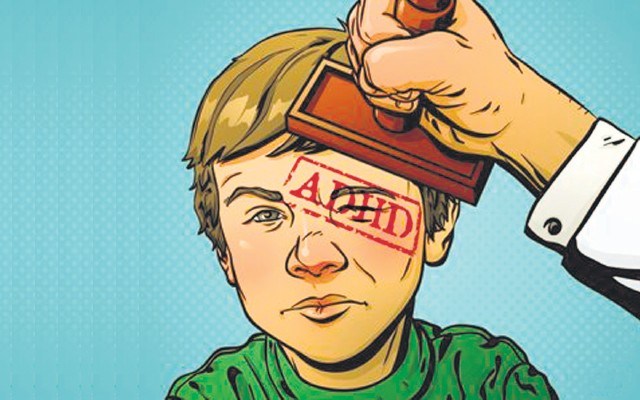
Image result for adhd

Let’s be clear: some young people are cleverer than others. Some are more energetic than others. Some are more inclined to bad behaviour than others. This isn’t to deny this, or claim there’s always a simple solution. The problem is the creation of labels. If a child is described as “hyper”, it’s typically been seen as a symptom of an over-energetic personality. Through rebuke and encouragement, they’re conditioned to overcome it and grow up. However, the situation with the modern labels is that the subjects are no longer treated as people with traits which can be changed, but as those with hard-wired faults that they’ll have for the rest of their lives. The word “hyperactive” has been capitalised, and that makes a massive difference.

One man I know could hardly contain his joy when the “experts”, probably psychology graduates who are trying to justify their mostly-bogus discipline, told him he had dyslexia. The difficulty in reading is real, I’m sure. Yet his delight was there because he had a way to explain his failure at school. Had they known, he told me, he’d have probably got the right help and succeeded academically. His lifelong fear—that he simply wasn’t that clever—was gone, and he could spend the rest of his days comforted by the knowledge of possessing a deep-down intelligence which has been repressed by an evil condition out of his control.

Perhaps in the future, a new condition will be invented for me. Instead of saying people have a poor memory, they’ll create “Memory and Attention Deficit” or MAD for short. People can have teachers give them clues in exams, and they could have their mark bumped up a few grades. I’ll maybe read it in the paper one day, and sigh with relief that underneath I’m a borderline genius, hindered by an invisible and insidious force preventing me from becoming the world leader in my field I think I should be. You see the problem here? What about robbers walking free because of Property Inequality Perception Disorder? Or rapists getting a suspended sentence if they’ve successfully applied for a Predatorial Violence Disorder diagnosis? No, it’s not totally different.

The first step needed is sadly also one that will never happen, but anyway, the labels will go first. Someone formerly “having” ADHD will lose the label (as useful as it is in some ways). We’ll use our collective brains to work out strategies to bring the behaviour under control, all the while laying the blame for bad behaviour at the feet of the child. Even if we know all the factors which brought it about, such as a bad upbringing, we teach them that they have to accept responsibility for their actions despite anything that they’ve suffered. If we can do this, we’ll destroy the ADHD industry, ending the big-pharma boom created by drugging millions of children (at a cost of up to $250 billion annually in the US alone), stopping the benefit abuse, handing responsibility for raising the children properly to the parent(s), and hopefully creating well-rounded young adults who are ready to enter the real world.
Posted by: Animus | November 28, 2017

The Selfishness of Gun Control

Gun control in the UK can be summed up like this: the elite want to have guns but ban the plebs from having them. It’s granted that our armies and some police officers need them; but we have “important” people protected by armed bodyguards, whilst they denounce as outrageous the notion of civilians being able to protect their families with firearms. (In the UK you can shoot targets and game but you can’t protect yourself using a gun.)

Successive governments have progressively outlawed the sporting use of firearms, and the only action taken when they do this is to force law-abiding citizens to hand over their cherished goods. Men, women and children, who have made the effort to learn about safe handling and security so they can enjoy their sport, have to queue up and give up their firearms as if they’d done something wrong. Meanwhile, the criminals who have guns sit back and laugh, since they at least understand the irony that laws apply only to the law-abiding; to them, it’s business as usual.

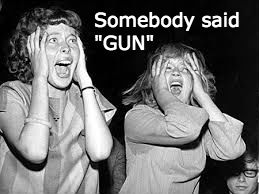
Many in the shooting community are fully aware of how the ratchet of gun-bans is able to work. A public, which mostly doesn’t shoot, selfishly thinks there is no reason to protect the rights of those who do, so the slightest evidence, however deceptive or illusory, is enough to create an emotional response among the masses for gun bans.Image result for hysterical reaction to guns This phenomenon of selfishness can easily be seen in the refusal of the public to countenance the banning of private motor vehicles and kitchen knives; they all use those things, so no number of children killed on the roads or suicides using kitchen knives will allow even the thought of banning these things. To put it another way, if everyone in the UK was involved in recreational shooting, all the proposals for bans would fail.

The message for shooters is to be an ambassador for your sport. Tell friends and family, and if possible recruit them to shooting. Even if you help them get just one chance to shoot, it will at least undermine the ridiculous stigma they’re likely to associate with guns.

The message to people who don’t shoot is this: you should be willing to protect the rights of your fellow man, even if you don’t share their interests. People in the UK who own guns must go through a rigorous screening, and have their licenses reviewed periodically. Guns are tools, and it’s good to encourage respect and responsible use of them, especially among young people. Don’t listen to the establishment media and governments. There are countries where high gun-ownership rates are accompanied by low crime-rates. It can be done.

Image result for uk shooting range women

A ladies’ shooting day

Posted by: Animus | July 15, 2016

A Voice for the Working Class

It shouldn’t surprise us that some people are confused about the “refugee crisis” in Europe. We see people from all over the world leaving their home countries for a variety of reasons, and when the average person describes them as “those immigrants”, the Guardianista jump on them and educate them about how we should distinguish between economic migrants, refugees and asylum seekers.

To an extent, it’s fair to ask people to take the time to identify people correctly before making broad statements. For example, someone escaping war in Iceland shouldn’t be lumped together with young, bored and violent Somalis who are willing to risk their lives to reach the Promised Land of the UK. Why? Because the danger they each face must be considered when weighing up how much help we may give them–if any. Also, it’s right that Indians are not called “Pakistanis” if they’re not. It’s about politeness if nothing else.

I imagine one of the Lefties who would be the first to insist on careful labelling of immigrants is the writer and columnist, Owen Jones. He wrote a book about the demonization of the working class, so you’d expect him to get behind them and plead for allowances to be made for those who maybe can’t articulate accurately their concerns about their country.

All the working class are equal, but some…

However, Jones’s own sympathy for the “lower classes” extends only to those who agree with him. Just ask Jones about the anger among the right-wing working class and see how far you get. He’s like every other logically inconsistent, metropolitan luvvie: it’s his way or the highway, and he therefore duly merits his place in my category of the Champagne Socialist. No doubt he’d claim he doesn’t even like champagne. Hard luck. The category’s staying, and he’s in it.

What we should do is try to avoid getting irritated by uneducated comment, and try to see if there’s any substance behind the poor rhetoric. (Often there isn’t!) But to deny people a voice because they haven’t enjoyed a public school upbringing and become the well-spoken finished product shouldn’t mean their voice is ignored. If anything, it’s up to the better educated to crystallize the disjointed expressions into arguments which reflect the heartfelt unease of this Joe Bloggs multitude. This is the job of the politician, surely, but they must avoid Jones’s prejudice and be prepared to represent views even if they find them hard to stomach.

Posted by: Animus | June 14, 2016

A Prophet Warns about Rulers

Although this post talks about someone in the Bible, it’s about something that people who have no interest in such things may be able to relate to.

There was a prophet of God called Samuel, who lived about a thousand years before Jesus Christ (c. 1100BC). The people of the Hebrews, although God’s chosen nation at that time, were persistently rebellious. Their latest fad was wanting a king.

The people had lived in a “theocracy”, a kind of direct rule by God through the medium of people like Samuel. This was the Age of the Judges. But like I said, the people wanted a king like everyone else.

Samuel had a message from God, which he relayed to the people. It was effectively a warning against having a king, but let’s fairly extend that to presidents and prime-ministers too. The people were warned that a king would:

  • Take your sons and send them to war
  • Enlist people to produce supplies and weapons for his armies
  • Steal land from the people and give it to his civil servants
  • Tax people heavily to pay for it all

Is it just me or is this the basis for virtually every dictator in history? The West may think it’s far from being a dictatorship, but the foundations of totalitarianism are there. The common elements seem to be the setting up of a significant civil service, the use of heavy taxes to maintain this system, and the use of that significant 10% or 20% to subdue the rest of the population, with the backing of the ruler’s forces (i.e. police and army) to reinforce their dominance.

If you’re politically minded, and see this on every horizon of every nation that has existed, I think you’re on the right track. Every ruling system is inevitably drawn towards the use of force to bring about their perfect society. Control, control, control. Consider how all these new laws only take freedoms away from us. A recent UK government stunt asked the population for suggestions of what unjust law they wanted repealing. A shortlist was drawn up. The winner—though you’d never know it—was repeal of the handgun ban. The government didn’t like the people’s decision, and had second thoughts. Asking the Proles to think was a mistake, so the entire project was quietly binned. Damn. If only we’d asked for the repeal of the bestiality laws. We’d have likely got further.

Want to do something about it? Make your aims small government, repeal of PC law, withdrawal from supranational political institutions like the EU, widespread firearms ownership, corporal punishment, promotion of the traditional family unit, restoration of commons land, massive reduction in taxes, and an insistence that any leader who wants to start a war against some foreign nation has to lead the troops into battle….and his sons must join him. What a much more peaceful world that would be.

What about those Hebrews? They were warned from God’s own representative of all these negative consequences of having a monarchy/president/prime-minister. They thought for a minute, then said, “Yeh…..but we’d like a king now, please.” Such is the blinkered thinking and fickle habits which are still around in today’s society.

Posted by: Animus | May 30, 2016

The Petit Bourgeois

In an old book I read recently, a very interesting observation was made which I thought was worthy of quoting, as we can see the same tendency within our own culture and time. I’m posting this as a follow-on from my previous two posts about people’s desires for higher status.

“Those among whom I passed my young days belonged to the small bourgeois class. Therefore it was a world that had very little contact with the world of genuine manual labourers. For, though at first this may appear astonishing, the ditch which separates that class, which is by no means economically well-off, from the manual labouring class is often deeper than people think. The reason for this division, which we may almost call enmity, lies in the fear that dominates a social group which has only just risen above the level of the manual labourer—a fear lest it may fall back into its old condition or at least be classed with the labourers. Moreover, there is something repulsive in remembering the cultural indigence of that lower class and their rough manners with one another; so that people who are only on the first rung of the social ladder find it unbearable to be forced to have any contact with the cultural level and standard of living out of which they have passed.

“And so it happens that very often those who belong to what can really be called the upper classes find it much easier than do the upstarts to descend to and intermingle with their fellow beings on the lowest social level. For by the word upstart I mean everyone who has raised himself through his own efforts to a social level higher than that to which he formerly belonged. In the case of such a person the hard struggle through which he passes often destroys his normal human sympathy. His own fight for existence kills his sensibility for the misery of those who have been left behind.

“From this point of view fate had been kind to me. Circumstances forced me to return to that world of poverty and economic insecurity above which my father had raised himself in his early days; and thus the blinkers of a narrow petit bourgeois education were torn from my eyes. Now for the first time I learned to know men and I learned to distinguish between empty appearances or brutal manners and the real inner nature of the people who outwardly appeared thus.”

Adolf Hitler, from his work Mein Kampf, about his early memories of living and working in Austria.

Posted by: Animus | May 30, 2016

The Champagne Socialist

In a previous post about certain stereotypes, I mentioned this latest aggravating character, the Champagne Socialist. The term is an obvious oxymoron, and describes someone on the political Left who masks his own desire for wealth as a fight for equality and fairness. This faker rails against capitalism and demands wealthier people be forced to give away their money, while simultaneously coveting riches for himself.

In the 1980s in the UK, the anti-capitalist Militant Tendency of the Labour Party arose, and one of its leading lights later became the poster-boy for champagne socialism, with expensive tastes in dining and fashion. Ironically, he started his own PR business, making money by the very system whose existence he wanted to overthrow.

The most extreme example of this phenomenon has to be the multi-millionaire rock stars. They give speeches about allowing mass immigration, taking in more refugees and promoting a multiracial West, while living in near-empty fifty-bedroom mansions in white havens. They ask the working man to dig deeper into the pockets to help various charitable causes while maintaining bank-balances of tens or hundreds of millions of pounds. If one of them could empty their bank account and maybe have just a little semi and a near new car, then give all their riches away to the poor, we could take them seriously. But none does, and all the while they never see their repulsive double standards.

Orwell saw this tendency in human nature very clearly, and expressed it in his book Animal Farm. If you haven’t read it, it’s based around a farm where the animals can talk. The pigs lead a rebellion against the capitalist farmer, but eventually become greedier and more tyrannical than the ruler they overthrew. It’s part of human nature to put themselves first, and as the Christian’s Bible says, “There is nothing new under the sun.”

Posted by: Animus | May 30, 2016

Something about working-class jealousy

No, that’s not right. The aspirations and jealousy of the working class. No, that’s not right either. Aspirational jealousy in….oh I give up. I can’t think of a suitable title. I can always revise it later, I suppose.

What’s this all about? A newspaper used to run a series on social stereotypes, each week describing a typical character of one sort or another. I know the usefulness of stereotypes is only partial, since we truly are all different from each other. Still, there’s some truth in them—and they make me laugh, which is the most important thing.

One character I’ve met many times is the one I unsuccessfully tried to describe in my title. Invariably male, he will be a blue-collar worker but with designs on middle-classery. He is not particularly intelligent, but fights to earn a reputation as clever, and may do this by several means. He will learn some “big words”, by which we include small words not often used. The circles he inhabits are often impressed by these words and respect him for his supposed intelligence. The worst examples of these men even add “ing” onto every word which in his normal dialect would be shortened to “in”. He will also try to exalt himself socially through habits which are perceived as middle- to upper-class, such as blagging his way as appreciative of fine wines, foods and clothing.

As I’m writing this, I find myself picturing a certain acquaintance of mine from many years ago. He was one of the first of this kind I noticed. A not-too-bright car mechanic, who went to cheese and wine parties and said “cooking a meal” instead of “cookin me dinner”. Oh yes, he ticked all the boxes.

Now here’s the biggest paradox of this character: he despises the very class of people which he aspires to belong to. Very often there will be deep-rooted socialist and anti-authoritarian beliefs. Yet he wants to not only be fully accepted by the very people he currently loathes but also put distance between those he thinks are now on a lower rung of the social ladder than he is.

Two stereotypes have been coined in recent history which fall broadly into our category. The first is a member of what Hitler calls the “small bourgeois”. The second is the appearance of the “champagne socialist”. More about these in my next posts…

Posted by: Animus | April 19, 2016

Revisionist History

The fundamental question looked at here is whether we should allow research and publication by those who reject widely accepted versions of historical events.

If I asked whether a free press was a requirement for a country’s freedom, most people would say “Yes”. If I asked whether transparency in government was essential for the same reason, most would agree. And the same people would nod approvingly if we suggested this openness should be seen throughout all areas of society.

However, the same people have gone along with a irreconcilable position which makes some subjects “off limits”. In science, enquiry is allowed almost universally—its establishment even boasts as much—yet their cherished hypothesis of Darwinism is sacrosanct. In the same way, history has its own ringfenced accounts, such as the Nazi Holocaust, and this is the example I want to use to encourage people to think about why they believe what they do about history and why some historical enquiry is suppressed.

We have all been subject to the accounts of what happened in the German concentration camps of WWII. The official story is that the Germans had a long term aim to wipe out Jews from the earth. To that purpose, they rounded up European Jews, imprisoned them in “death camps”, then systematically killed six million of them in gas chambers. There is no shortage of people who claim to have been eyewitnesses to all this, and their testimonies have been held up as infallible. There are also others whose accounts contradict these, but they are mostly ignored.

Although most would deny it, their beliefs about history are based on the shallowest enquiry. To put it this way, they’ll see something on the TV and assume it must be true, since the programme interviews numerous experts. The idea of bias and reactionary attitudes pervading the history community is unthinkable, since “experts” have been exalted almost to the status of infallibility.

Why would certain takes on history be exempt from scrutiny? With the Nazi episode, Jewish influence in society has caused not only their story to be accepted universally, but fear that a mere question about their cherished account will cause widespread anti-semitic hatred and violence. Their argument is based on the premise that anyone who’d want to ask probing questions is also the type who would not be opposed to that sort of behaviour. Ironically, the demonization of the Right should likewise cause hatred and violence towards them, but it seems that this doesn’t matter. Presumably, violence is okay after all, as long as it’s carried out against “bad” people. Oh, and guess who gets to decide on these labels?

It’s beyond the scope of this post to examine these accounts and those of the revisionists who deny this whole Holocaust narrative. My argument is that the creation of laws against historic enquiry are a mistake. A number of countries have legislated against research into the Holocaust episode, and it’s not unreasonable to be worried that this censure of investigation could be extended to other areas, both historical and scientific. Some will welcome these laws, but their vision is limited to what is convenient to them. When the law encroaches onto their forums for debate, then they will understand. But it will be too late.

Posted by: Animus | February 20, 2015

The World of The Hunger Games

If you haven’t watched the film adaptations of Suzanne Collins’s books, you should. It might seem like The Hunger Games films are for teens, since the books were written for young adults. However, some of the issues which the films will raise in people’s minds won’t occur to much of their younger fans.

The setting for the films is a dystopian, future world, and it’s implied that a global catastrophe left only one continent remaining. The country’s made up of a dozen or so districts, whose inhabitants live in various levels of poverty. At its centre is a city, The Capitol, a hive of hedonism, where metropolitan extravagance blurs gender distinctions, and gluttons induce vomiting so they can continue their feasts—an ancient Roman habit.

References to ancient Rome can be seen in characters’ names, too: if Katniss is the figurehead of the rebellion which the story is about, then Plutarch Heavensbee is its architect. Early in the series, he makes hints to Katniss about rebellion and—in the manner of the Greco-Roman philosopher after whom he was named—his disdain for the immorality of the Capitol.

Another reference is in the name of the country itself, Panem. It would be strange to call a country “bread”, which is what the Latin word means. It could be that Collins liked the sound of it; but with all the other Roman references in her books, we should be looking at another explanation. The most famous phrase with that word in is panem et circenses, or “bread and circuses”. It’s from another famous Roman bloke, called Juvenal. He saw a society which had largely abandoned participation in current affairs and the political process, preferring instead the satisfying of immediate and short-sighted wants. The Romans supplied their subjects’ shallow desires with free wheat (the bread), and trivial entertainment (the circuses), and this diet kept the “lower classes” in a state of constant distraction.

Sound familiar? You may think it’s a stretch to say so, but let me draw parallels with today’s Western society. (Make that wealthy society. Why should the emerging economies of the East be let off?)

We’re seeing today a widening gap between rich and poor. You may rightly propose that unjust inequality has always been with us, and I’d not argue against that; but each year, the wealth of the planet is possessed by an increasingly smaller proportion of the world’s population, and in the West the middle classes are getting poorer. You could also argue, without opposition from me, that large cities have always been Bohemian and more liberal; yet now, more than any time in history, we have a society heading in the same direction as Panem. This is not just about an emerging police state.

The Romans gave free food to its people. We give massive handouts in a multitude of benefits payments, and without doubt some people are happy to live off these handouts. The same people are invariably fans of mindless TV trash, like reality television and soaps, and football has become almost a religion to many. It’s not even that this stuff’s not entertaining, and watching it doesn’t in itself prove anything about you; but an increasing wedge of the population, a poor section, is content to live with the sustenance of free money and banal entertainment. Do you need more evidence? How about the shrinking involvement in political action and voting? Here’s the full quote from Juvenal:

“Already long ago, from when we sold our vote to no man, the People have abdicated our duties; for the People who once upon a time handed out military command, high civil office, legions — everything, now restrains itself and anxiously hopes for just two things: bread and circuses.”

I’m not an advocate of violent uprisings, but the rich need not fear anyway. Unlike the oppressed of Panem, today’s poor are happy in the distractions being fed to them by those who want to keep them in a state of apathy.

Posted by: Animus | June 2, 2014

The Mixing Deck of Intelligence

It’s commonly believed that intelligence is like a volume control. You’re born cranked all the way up, quietly dim, or somewhere in-between. Well that’s the way I saw it. Then I got into the world of work and discovered that people who were less intelligent in an academic sense often had more common sense—you know, had their heads screwed on more. This got me wondering whether their lower IQ enabled them to somehow see things without the fog of analysis.

When I entered university, I found myself surrounded by clever people, naturally. If it’s a humbling experience you’re after, try a degree in a technical subject. There’s no better place to make you feel like you have the IQ of a highly-functioning goat.

Joining MENSA, the high IQ society helped keep at bay those inward suspicions that I’d somehow blagged my way into university, a gatecrasher into the brainy party. Still, though, you meet these people who just look at stuff you can barely understand, and it just leaps out at them, as clear as anything. They study, but do they really study as hard as me? I doubt it. They see mathematics in the same way as a composer like Beethoven saw musical notation, and it amazes me.

Was there any hope for people like me? My thoughts progressed when I witnessed what happens when you take these clever-clogs (i.e. anyone cleverer than me) out of their tech comfort zone. They all have their weaknesses. One might be a whizz-kid at maths, yet look bemused when your talk changes to the philosophical or abstract.

Hence the ‘mixing deck’. If we picture it, with dozens of sliding controls, it’s a good symbol of what intelligence is really like. Every individual is different. Each has strengths and weaknesses in different areas. True, really brainy people will have a lot of sliders near the top, and the poor thick people will have most near the bottom. Yet the levels are unique, and your average dim person can be thankful that they might possess a mental agility in a couple of areas such that they’d leave the brainboxes behind, left in the dust, pressing their glasses back on their noses and wiping soot from their calculators.

My conclusion is that describing someone as ‘intelligent’ is not very useful at all.

Older Posts »

Categories

Design a site like this with WordPress.com
Get started